What Does "Proxies" Mean? A Developer's Guide
September 14, 2026
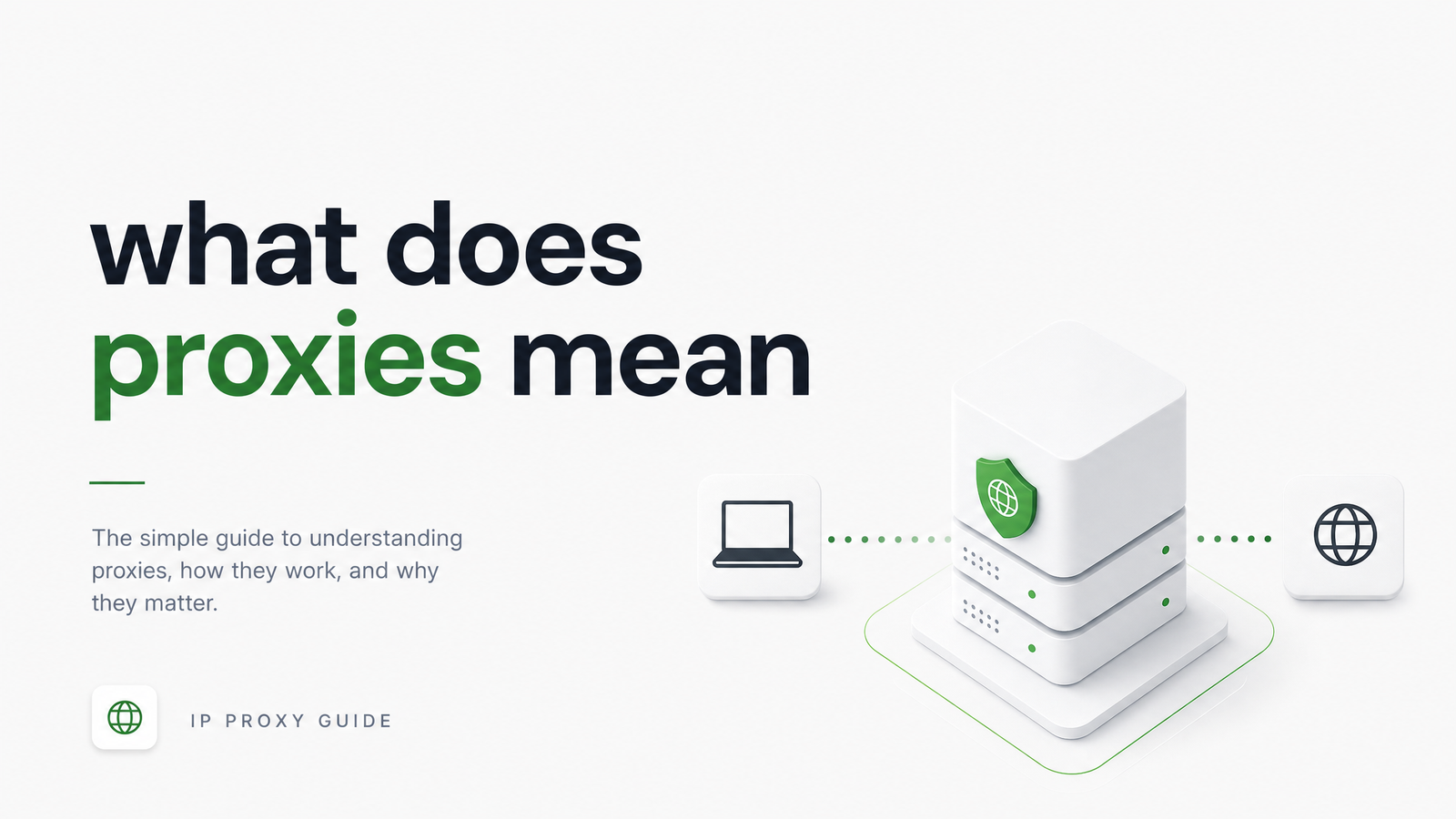
What Does "Proxies" Mean?
A proxy server is an intermediary that sits between a client making a request and the destination server that request is aimed at. Instead of your machine talking directly to a website, it talks to the proxy, and the proxy talks to the website on your behalf — like a receptionist who delivers your message and brings back the reply, so the office never sees you directly.
That's the core proxy meaning in networking: an in-between node that relays traffic and changes what the destination perceives about the origin of the request. The plural, "proxies," usually refers to a pool or network of such intermediaries — a system might route requests through dozens, hundreds, or thousands of proxy servers to distribute traffic or vary its apparent origin. So when someone asks what does proxies mean in a technical setting, they're typically asking about this infrastructure layer, not the general consumer idea of "a proxy" as a single privacy tool. That distinction matters once you're building anything that talks to the web programmatically.
How a Proxy Server Actually Works
Mechanically, what is a proxy server doing on each request? The client sends its request to the proxy instead of the target. The proxy opens its own connection to the destination, forwards the request, receives the response, and relays it back to the original client. From the target server's point of view, the request came from the proxy's IP address — not yours.
This is the mechanism behind IP masking: the destination logs and rate-limits the proxy's identity, not the origin machine's. It's also why proxies matter for automated outbound traffic. A website's server-side logic — rate limiters, geo-restrictions, abuse detection — makes decisions largely based on the IP address it sees. Change that IP, and you change how the request is treated, at least at that layer. That's what a proxy does at its most fundamental: a relay that substitutes its own network identity for yours, request in, response out, without altering the payload itself.
The Main Types of Proxies
Understanding the types of proxies means separating two independent questions: which direction does traffic flow, and where does the IP actually come from?
Direction: forward proxy vs. reverse proxy. A forward proxy sits in front of clients, forwarding their outbound requests to the internet — the setup most relevant to scraping, automation, and API clients. A reverse proxy sits in front of servers, accepting inbound requests on a server's behalf and routing them internally — think load balancers or CDN edge nodes. Confusing the two is a common source of misreadings in vendor documentation, since "proxy" alone doesn't tell you which side of the connection it's protecting.
Origin: datacenter, residential, ISP, and mobile. These describe where the IP address actually lives:
- Datacenter proxies originate from cloud/hosting infrastructure. They're fast and cheap but easy to flag, since datacenter IP ranges are well known and rarely belong to real consumers.
- Residential proxies use IPs assigned by ISPs to real home connections, making traffic look like an ordinary household user — the residential proxy vs. datacenter proxy distinction developers hit constantly: harder to block but slower and more expensive.
- ISP proxies are a hybrid — IPs registered to internet service providers but hosted in data centers, offering some residential-style legitimacy with datacenter-level speed.
- Mobile proxies route through IPs assigned to cellular carriers, especially hard to block since carrier-grade NAT means many real users share the same address.
Which one a developer picks depends entirely on what's being accessed and how aggressively it's defended.
Why Developers Use Proxies in Web Scraping
For proxies for web scraping, the practical motivations are concrete. A single IP hammering an endpoint quickly hits rate limits or gets blocked, so proxy rotation — cycling through a pool of IPs across requests — spreads that load so no single address looks abusive. Geo-targeting is another driver: some sites serve different pricing, inventory, or content by region, and a proxy located in the right country lets you retrieve what a local user would see. And at scale, distributing requests across many IPs is simply how you avoid one address becoming a bottleneck across a large scraping job.
None of this is exotic — it's standard infrastructure for anyone pulling data from the web programmatically rather than treating proxies as a one-off privacy tool. If you're designing the surrounding system, it's worth understanding how proxies fit into a full scraping architecture alongside queues and workers, since the proxy layer is only one piece of a working pipeline.
What Proxies Don't Solve
Here's where expectations often break: a proxy changes your IP address and nothing else. It does nothing about the other signals a site can inspect to distinguish bots from browsers.
TLS handshakes carry a fingerprint — often called JA3 — derived from cipher suites, extensions, and negotiation order. A plain HTTP client and a real browser produce different TLS fingerprints even from the identical IP, and detection systems check this independently of address. Headers matter too: a scraper sending an inconsistent or incomplete header set stands out regardless of which IP sent it. And if the target page relies on JavaScript to render content or issue a challenge — the kind of check that only executes in an actual browser engine — a bare HTTP request through a proxy simply won't produce it.
This is the real difference in the proxy vs. headless browser comparison: a proxy handles network-layer identity, while bot detection increasingly operates at the rendering and fingerprinting layer. A rotating pool of clean residential IPs paired with a client that fails TLS fingerprinting or never executes JavaScript will still get flagged. If your traffic is going through Cloudflare specifically, it's also worth understanding what "Proxied" actually means in that context, since that's a narrower, DNS-specific usage of the same word.
Proxies remain necessary — but they're one layer in a stack, not the whole defense. The other layer is real rendering: a headless browser that executes JavaScript, presents a consistent TLS/JA3 profile, and behaves like an actual client. That's the piece Browsevra is built around — check the docs to see how rendering and detection evasion are handled directly, or the pricing page if you're weighing a managed alternative to maintaining your own proxy-and-browser stack.
Frequently Asked Questions
What's the difference between a proxy and a VPN?
A proxy typically routes traffic for a specific application or request type and doesn't necessarily encrypt it, while a VPN encrypts and tunnels all traffic from a device at the operating system level. Proxies are commonly used per-request or per-session in automation and scraping contexts; VPNs are built for whole-device privacy and security.
Is it legal to use proxies for web scraping?
Using proxies themselves is legal; the legality question depends on what data you're collecting, how you're accessing it, and whether you're complying with a site's terms of service and applicable laws. Scraping publicly available data is generally lower-risk than bypassing authentication or collecting personal data without a lawful basis, so evaluate each target case by case.
What's the difference between a forward proxy and a reverse proxy?
A forward proxy sits in front of clients and forwards their outbound requests to the internet, which is the relevant setup for scraping and automation. A reverse proxy sits in front of servers, handling inbound requests on the server's behalf — commonly used for load balancing and CDN edge routing.
Do I still need a proxy if I use a headless browser API?
Often yes, since a headless browser solves rendering and fingerprinting but doesn't change your IP address or distribute request volume. Proxies and headless rendering address different layers of the same detection problem, and most production scraping stacks use both together.
What's the difference between residential and datacenter proxies?
Residential proxies use IPs assigned by ISPs to real home connections, making them harder for sites to flag but slower and costlier. Datacenter proxies come from hosting infrastructure — fast and cheap, but easier for detection systems to recognize and block.
Why do websites block requests even when I'm using a proxy?
Because IP address is only one signal among many; sites also check TLS/JA3 fingerprints, header consistency, and whether JavaScript executes as a real browser would. A clean IP from a proxy won't help if the rest of the request doesn't look like it came from an actual browser.